
AMR Awareness Week 2025 Part 1: The quiet advance of antibiotic resistance
The aim of the global AMR Awareness Week is to raise public awareness for antibiotic resistance and to discuss solutions to the problem. This blog series will give an insight into the pharmaceutical industry’s role in the fight against antibiotic resistance.
Antibiotic resistance describes the ability of bacteria to adapt to and resist the effects of antibiotics. Resistant bacteria can make treating an infection more difficult, prolong it or, in the worst case, even make treatment impossible. When we take an antibiotic, it kills most of the bacteria that are causing an infection. However, some bacteria might survive because they have a mutation in their genome that makes them resistant. These surviving bacteria can reproduce and pass on their resistance to other bacteria.
Over time, this leads to the formation of entire strains of bacteria that cannot be treated using certain antibiotics. In addition, bacteria can also pass on their resistance to other bacteria, including completely different species of bacteria. This means the problem quickly spreads. The more antibiotics that are used – in humans, animal husbandry or agriculture, for example – the more the bacteria are forced to adapt. Sensitive strains disappear while resistant ones survive.
Global resistance trends indicate a reduction in the effectiveness of antibiotics and forecasts suggest that, by 2050, these resistances could lead to 10 million deaths worldwide every year [1].
One important factor contributing to the development of antibiotic resistance is the excessive and inappropriate use of antibiotics in humans as well as in veterinary medicine and animal husbandry.
Other factors include:
- Incorrect use – for example, not taking the treatment for long enough, in the wrong context (e.g. viral infection) or discontinuing it.
- Incorrect dosage – taking either not enough or unnecessarily strong antibiotics.
All of this promotes the development of resistance and allows bacteria that are already resistant to survive, reproduce and spread. That’s why it’s important to use antibiotics responsibly and exactly as prescribed by your doctor. Analysis of the use of antibiotics in Switzerland, shows that 87 percent of antibiotics are prescribed in doctor’s offices and 13 percent in hospitals. In addition to differences between hospitals and doctor’s offices, there are also differences between language regions. French-speaking Switzerland is the leader in terms of antibiotic consumption per capita, while German-speaking Switzerland is in third place [2].
Scope of the problem
The consequences of resistances developing are far-reaching. According to the WHO, antibiotic resistance in the pathogen-antibiotic combinations investigated increased by 40 percent between 2018 and 2023. There are also significant differences between global regions – Southeast Asia is the most affected region.
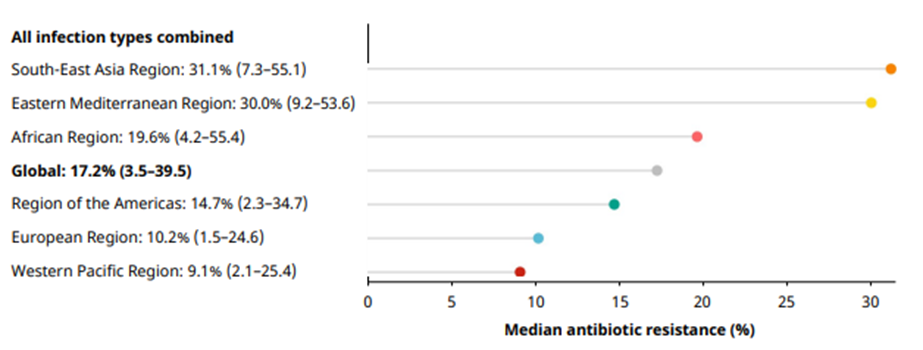
The problems with antibiotic resistance are particularly prevalent in countries with weaker healthcare systems. Causes include a lack of diagnostic testing and insufficient financing of the healthcare system, which leads to incorrect use or treatments that are too short. Hygiene in healthcare facilities and the shortage of vaccinations also play a part [3].
Looking at deaths in 2021, 7.7 million people worldwide died from a bacterial infection. 1.1 million of these deaths are the direct result of antibiotic resistance [3].
A global phenomenon
Antibiotic resistance doesn’t just develop in hospitals, but also in everyday life, in veterinary medicine and in agriculture. Resistant pathogens do not have any boundaries: they spread through people, animals, food and water all over the world. The close relationship between human, animal and environmental health is described in the One Health approach – a concept that recognizes antibiotic resistance as an interconnected, global problem [4].
A rethink is taking place
The urgency of this global issue is increasingly being recognized by the public and private sectors. For example, the Strategy on Antibiotic Resistance Switzerland (StAR), launched in 2015, aims to ensure the long-term effectiveness of antibiotics for the treatment of humans and animals through action at various levels. These actions include promoting the correct use of antibiotics, infection prevention in hospitals, monitoring resistance and antibiotic consumption, promoting research, sharing knowledge and raising public awareness. A rethink is taking place, but action is still needed, especially regarding research incentives.
Swiss patients wait a long time for new antibiotics
Patients in Switzerland wait significantly longer for new antibiotics to become available than in other countries. Of 18 antibacterial substances, by the end of 2019 only six had been approved in Switzerland. delay, These six substances made it onto the Swiss market on average 2.5 years after approval in the first country. Switzerland ranked eleventh out of the 15 countries listed in terms of the number of available antibiotics and in the “waiting time” ranking. So, there is still a lot to be done in this area:
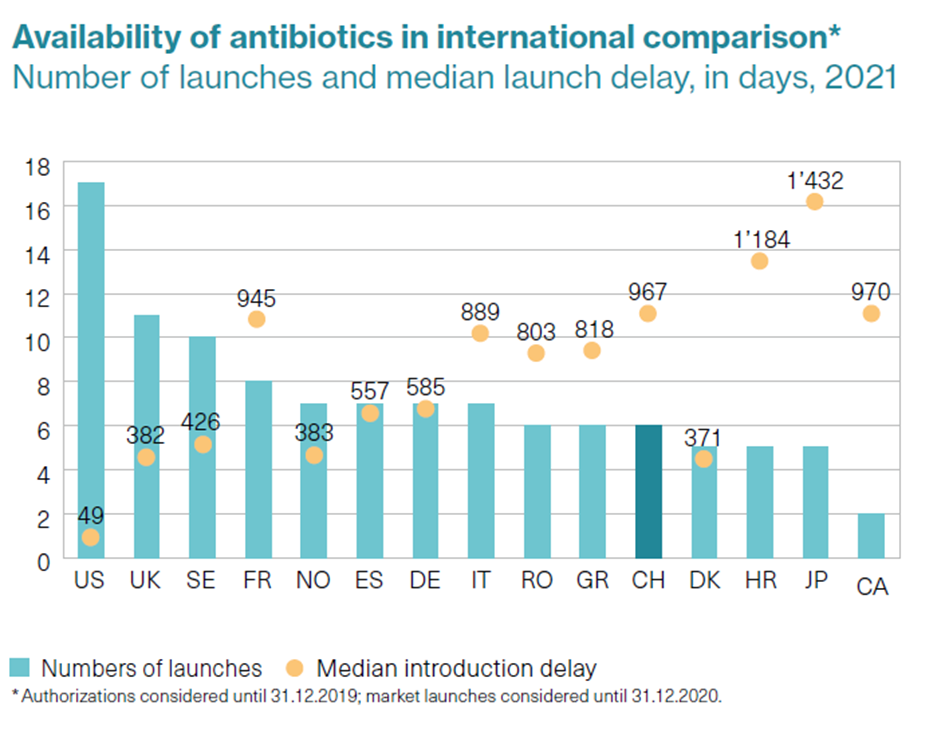
In order to prevent this “brain drain”, meaning the withdrawal or disappearance of innovative research companies from the field, and to strengthen the development of new antibiotics, various countries such as the US, the UK, and Sweden have tested or introduced incentive systems for antibiotics. Such incentives can take the form of market entry premiums or annual guaranteed payments that are independent of sales.
Specific incentives are needed:
- New antibiotics should be seen as insurance against future health crises. Therefore, when prices are set, the social value, i.e. ensuring the availability of new antibiotics as reserve medication for the treatment of multidrug-resistant bacteria, should be taken into account in addition to the value for patients.
- New antibiotics are kept in reserve for medical reasons and only used when older antibiotics fail. However, this means that manufacturers lack a market and have not way of covering development, manufacturing and distribution costs. To ensure the long-term availability of antibiotics research and market incentives are necessary. Market incentives decouple prescription volume and sales, which allows companies to make reserve antibiotics available.
Click here for part 2 of the blog series
Click here for part 3 of the blog series
Read more about antibiotic resistance and the pharmaceutical industry here.
[1] 160525_Final paper_with cover.pdf
[2] Fact sheet: Swiss Antibiotic Resistance Report 2024
[3] WHO: Antibiotikaresistenz steigt weltweit deutlich an [WHO: Antibiotic resistance is increasing significantly worldwide]